
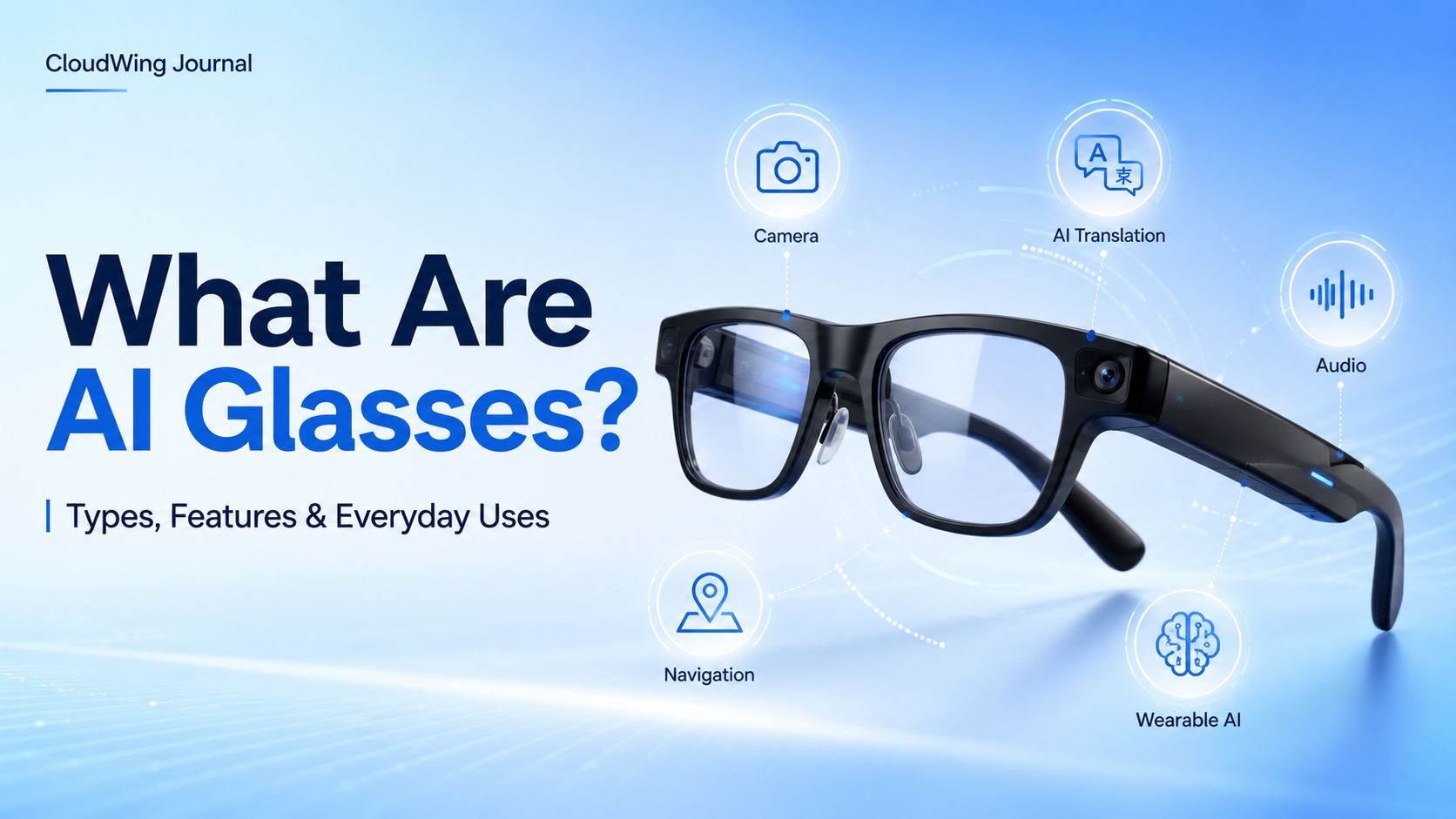
What Are AI Glasses?
AI glasses are a new generation of wearable devices that combine the familiar form of everyday eyewear with cameras, microphones, speakers, wireless connectivity, processors, and artificial intelligence.
Some AI glasses focus on audio and voice interaction. Others can capture first-person photos and videos, recognize objects, translate conversations, display navigation instructions, or present digital information directly in the wearer’s field of view.
In simple terms, AI glasses aim to bring some of the most useful functions of a smartphone, computer, camera, and wireless earbuds into a lightweight, hands-free device.
They represent an important step toward technology that feels more natural, less distracting, and more closely integrated into everyday life.
How Do AI Glasses Work?
AI glasses use a combination of hardware, software, and connectivity.
Depending on the model, the frame may contain:
- Cameras for capturing photos, videos, and visual information
- Microphones for voice commands and conversation input
- Open-ear speakers for calls, music, and spoken feedback
- Processors for local computing and device control
- Sensors for movement, orientation, or environmental awareness
- Wireless connectivity for pairing with a smartphone
- AI software for translation, recognition, summarization, and assistance
- Optional displays for subtitles, navigation, and digital overlays
Some functions are processed directly on the glasses, while more complex AI tasks may be handled through a connected smartphone or cloud-based service.
This allows the glasses to remain relatively lightweight while still providing intelligent features.
The Five Main Types of AI Glasses
AI glasses are not a single product category. Different designs focus on different user needs.
1. Audio AI Glasses
Audio AI glasses combine a traditional glasses frame with built-in microphones and open-ear speakers.
Typical functions include:
- Bluetooth calling
- Open-ear music
- Voice assistant access
- Voice questions and answers
- Audio notifications
- Meeting recording
- Voice memos
These glasses normally do not include a camera or visual display. Their main advantages are simplicity, comfort, privacy, and relatively accessible pricing.
Audio AI glasses are suitable for commuting, office work, calls, and everyday listening.
2. Camera AI Glasses
Camera AI glasses add one or more cameras to the audio functions of smart eyewear.
They may support:
- Hands-free photos
- First-person video recording
- Object recognition
- Text scanning
- QR code recognition
- Visual AI assistance
- Voice-controlled capture
- Real-time translation through a connected application
Camera AI glasses are currently one of the most practical smart-eyewear categories because they allow users to record what they see without holding a phone or camera.
They can be useful for travel, content creation, work documentation, learning, and everyday moments.
3. Waveguide AR Glasses
Waveguide glasses use optical technology to project digital information into the user’s field of view while allowing them to continue seeing the real world.
Possible functions include:
- Turn-by-turn navigation
- Live subtitles
- Translation captions
- Floating prompts
- Remote assistance
- Real-world labels
- Presentation guidance
Unlike ordinary camera glasses, waveguide glasses can visually present information in front of the wearer.
They are especially relevant for navigation, professional training, presentations, and augmented-reality applications.
4. Full-Color Display AI Glasses
Full-color display glasses provide richer visual content through built-in microdisplays.
They may support:
- Color notifications
- Media playback
- Screen mirroring
- Floating application windows
- Real-time subtitles
- Contextual information
- Augmented-reality content
This category offers a more immersive experience but usually requires more processing power, battery capacity, and optical hardware.
Full-color display glasses are designed for users who want deeper visual interaction rather than audio-only assistance.
5. Adaptive-Focus AI Glasses
Adaptive-focus glasses are an emerging category designed to adjust visual focus according to the wearer’s needs or viewing distance.
Potential applications include:
- Automatic focus adjustment
- Multi-distance viewing
- Eye-fatigue monitoring
- Vision-support modes
- Personalized lens settings
- Reading and screen-use assistance
This technology remains at an earlier stage than audio or camera AI glasses, but it may eventually combine smart eyewear with personalized vision care.
What Can AI Glasses Do?
The exact capabilities depend on the hardware and software included in each product. However, several functions are becoming increasingly important.
Real-Time Translation
AI glasses can capture speech through built-in microphones and translate it through a connected AI service.
Depending on the product, the translated result may be played through the speakers, displayed in a mobile application, or shown as subtitles in the wearer’s field of view.
This can support:
- International travel
- Multilingual meetings
- Everyday conversations
- Language learning
- Customer communication
Translation quality, supported languages, response time, and internet requirements vary between devices.
AR Navigation
Display-equipped glasses can show navigation prompts directly in front of the wearer.
Instead of repeatedly checking a smartphone, users may see arrows, distances, or turn instructions while walking.
This could make navigation more convenient in unfamiliar cities, airports, shopping areas, and other public spaces.
Smart Meeting Notes
Microphones can capture conversations or meetings, while AI software can turn the recording into:
- Transcripts
- Key points
- Summaries
- Action items
- Follow-up notes
This may help professionals concentrate on the conversation rather than manually writing every detail.
Recording laws and workplace privacy rules should always be respected.
In-Lens Prompts
Some display glasses can show notes, scripts, reminders, or presentation prompts in the user’s field of view.
This can be useful for:
- Presentations
- Public speaking
- Training
- Guided procedures
- Interviews
- Live demonstrations
The goal is to provide useful information without requiring the user to look down at a phone or printed document.
Hands-Free Photography
Camera-equipped AI glasses can capture photos and videos from a first-person perspective.
This makes them useful for:
- Travel memories
- Outdoor activities
- Tutorials
- Work documentation
- Social content
- Everyday experiences
Users should pay attention to privacy, local laws, and the comfort of people around them when recording.
AI Assistance
AI glasses can provide voice access to intelligent assistants.
Users may be able to:
- Ask questions
- Check information
- Create reminders
- Plan activities
- Translate text or speech
- Identify objects
- Summarize content
- Control connected devices
The long-term vision is to make AI assistance available naturally throughout the day without requiring constant interaction with a phone screen.
Why Do AI Glasses Matter?
AI glasses matter because they change how people interact with digital information.
Smartphones are powerful, but they require users to stop, look down, unlock a device, and interact with a screen. AI glasses can reduce some of these steps by using voice, audio, cameras, and visual overlays.
This creates several potential benefits:
- More natural interaction
- Faster access to information
- Hands-free communication
- Less dependence on phone screens
- Easier first-person capture
- More context-aware assistance
The most successful AI glasses will not necessarily be the products with the longest feature lists. They will be the products that make useful tasks simpler without making the wearer feel distracted or uncomfortable.
Who Can Benefit From AI Glasses?
AI glasses may be useful for different groups of users.
Travelers
Translation, navigation, photography, and open-ear audio can make travel more convenient.
Professionals
Meeting transcription, voice notes, reminders, and hands-free communication may improve productivity.
Content Creators
First-person photography and video recording make it easier to capture natural moments.
Commuters
Open-ear audio allows users to listen while remaining aware of their surroundings.
Students and Learners
Translation, text recognition, voice notes, and AI explanations may support learning.
Technology Enthusiasts
AI glasses provide an opportunity to experience new forms of wearable computing.
How to Choose AI Glasses
Before choosing a pair of AI glasses, consider the functions you will actually use.
Ask the following questions:
- Do you mainly need calls and music?
- Do you want a built-in camera?
- Is real-time translation important?
- Do you need information displayed in your field of view?
- How important are weight and all-day comfort?
- Does the product require a smartphone application?
- Which languages and AI services are supported?
- How long does the battery last during real use?
- Can prescription lenses be installed?
- How is personal data stored and protected?
It is also important to understand that the term “AI glasses” covers products with very different capabilities.
Some models are essentially audio glasses with voice assistance. Others include cameras but no display. More advanced products may provide AR navigation, subtitles, and visual information.
Understanding these differences can help users avoid unrealistic expectations.
Current Limitations of AI Glasses
AI glasses are developing quickly, but the category still faces several challenges.
Battery Life
Small frames leave limited space for batteries. Camera recording, displays, and AI processing can consume power quickly.
Heat and Weight
More hardware can increase weight and generate heat, which may reduce comfort during extended use.
Privacy
Cameras and microphones create legitimate privacy concerns. Clear recording indicators and responsible use are essential.
Connectivity
Many advanced features require a smartphone connection or internet access.
Display Quality
Visual displays must balance brightness, clarity, field of view, power consumption, and size.
AI Accuracy
Translation, recognition, and summarization are not always perfect. Important information should still be verified.
These limitations do not mean AI glasses are impractical. They simply show that users should choose products according to real needs rather than marketing claims.
The Future of AI Glasses
The future of computing may extend beyond phones, tablets, and laptops.
As processors become smaller, batteries improve, and AI becomes more capable, smart glasses may become a more common way to communicate with digital services.
Future AI glasses could offer:
- More natural voice interaction
- Better real-time translation
- Longer battery life
- Lighter frames
- Improved prescription-lens support
- More private on-device AI processing
- More useful visual information
- Better integration with phones and other devices
The biggest opportunity is not to place every smartphone application in front of the user’s eyes. It is to identify the moments when hands-free assistance is genuinely more useful than a traditional screen.
Final Thoughts
AI glasses combine familiar eyewear with intelligent digital functions.
Depending on their design, they may support audio, photography, translation, navigation, productivity, visual information, and AI assistance.
The category is still evolving, and no single type of AI glasses is ideal for every user. Audio glasses prioritize simplicity, camera glasses focus on capture and recognition, while display glasses provide more advanced visual interaction.
For consumers, the most important step is to understand what each product can actually do and choose a device that fits naturally into everyday life.
As AI and wearable hardware continue to improve, glasses may become one of the most important ways people interact with technology—more naturally, more immediately, and with fewer screens.