
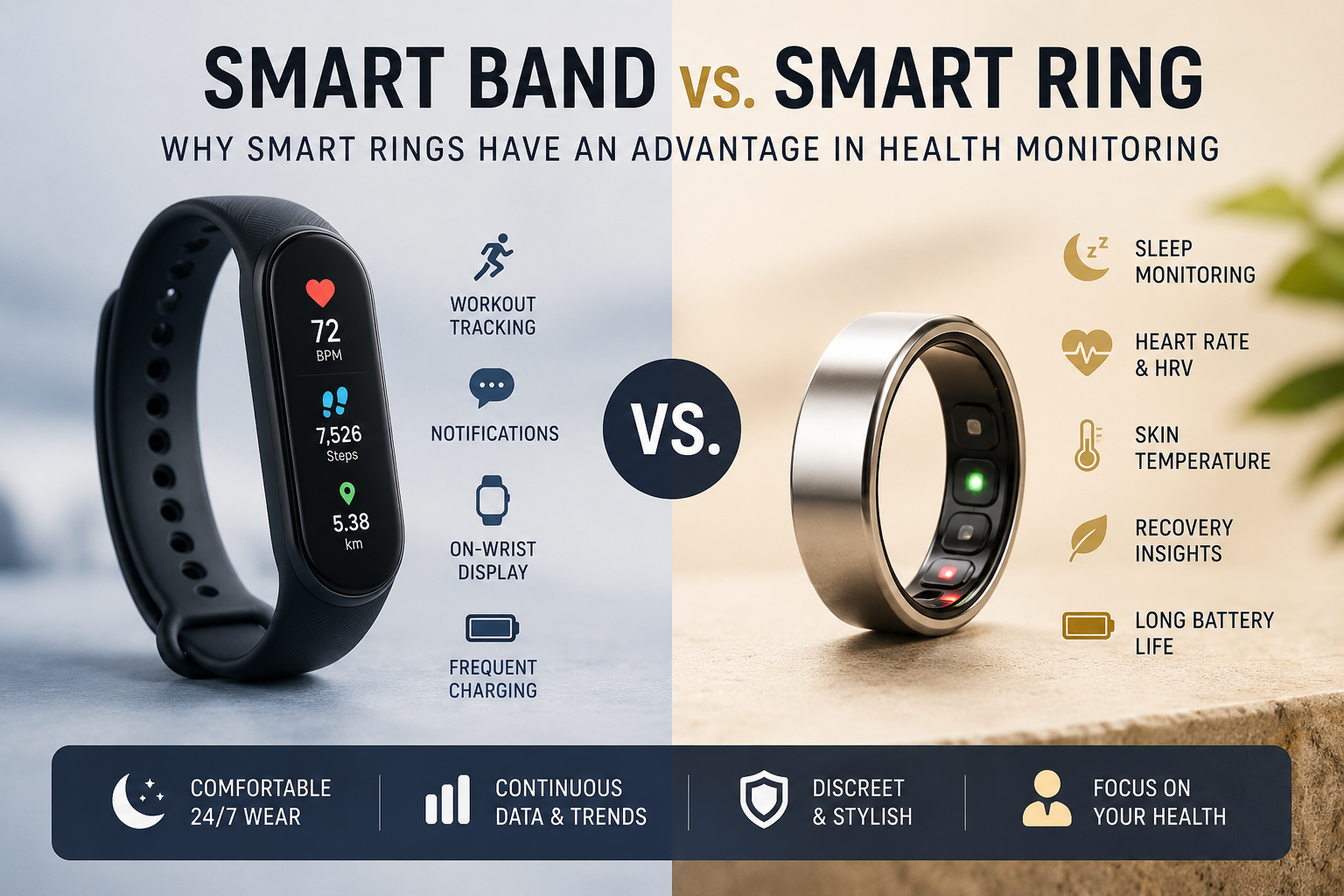
Wearable technology is gradually shifting from simply recording activity to helping people understand their bodies.
For many users, a smart band was their first health-focused wearable. It could display the time, count steps, show notifications, and provide heart rate and calorie data during exercise.
In recent years, smart rings have entered the mainstream. They do not rely on a prominent display or constant interaction. Instead, they focus on quietly collecting information such as sleep patterns, heart rate, heart rate variability, skin temperature, and recovery status.
Although smart bands and smart rings both belong to the wearable technology category, they are designed around different priorities:
- A smart band is a lightweight fitness tracker and notification device.
- A smart ring is a discreet, continuously worn health sensor.
For users who value workout tracking, on-device information, and notifications, a smart band remains highly practical.
For those who want to understand long-term sleep, stress, and recovery trends, however, a smart ring can offer clear advantages.
The Main Differences Between a Smart Band and a Smart Ring
A smart band is worn on the wrist and usually includes a display. Users can directly check the time, steps, heart rate, exercise status, and smartphone notifications.
A smart ring is worn around the base of a finger. It is smaller and usually has no screen. Its sensors are built into the inner surface of the ring, while health insights are displayed through a companion smartphone app.
| Comparison | Smart Band | Smart Ring |
|---|---|---|
| Wearing position | Wrist | Finger |
| Display | Usually included | Usually screen-free |
| Main purpose | Fitness tracking, notifications, daily interaction | Sleep, recovery, and long-term health trends |
| Viewing workout data | Easy during exercise | Usually requires a phone |
| Overnight comfort | May feel noticeable | Usually lighter and less intrusive |
| Health focus | Steps, exercise heart rate, calories | Resting heart rate, HRV, sleep, temperature trends |
| Interaction style | Actively checked and operated | Passively records and analyses |
| Appearance | Sporty and technology-focused | Closer to traditional jewellery |
The biggest difference is not simply where the device is worn. It is how each product approaches health.
A smart band mainly asks:
How much activity did you complete today?
A smart ring is more likely to ask:
How well has your body recovered today?
Why the Finger Is a Useful Location for Health Sensing
Many smart bands and smart rings use photoplethysmography sensors, commonly known as PPG sensors.
PPG sensors shine light into the skin and measure changes in reflected light caused by blood flow. These signals can be used to estimate heart rate, pulse intervals, and other physiological indicators.
The fingers contain a dense network of small blood vessels. A properly fitted ring can also maintain contact with the skin from several directions. When the wearer is relatively still, the finger can provide a strong location for collecting pulse-related signals.
By comparison, wrist-based devices can be affected by:
- A loose strap or incorrect placement
- Wrist bones and tendons reducing stable contact
- Movement during daily activities
- Sweat, skin temperature, and ambient light
- The device shifting position during sleep
This does not mean every smart ring is automatically more accurate than every smart band.
Sensor quality, algorithms, device design, fit, and wearing habits all influence the final result.
A more accurate conclusion is that the finger provides a promising position for heart rate and pulse-signal collection, particularly during sleep and periods of rest.
Five Health-Monitoring Advantages of Smart Rings
1. Better Suited to Continuous Wear
The real value of health monitoring does not come from a single reading. It comes from long-term trends.
A device worn only during exercise can capture only a small part of the body’s overall condition.
Because a smart ring is compact and resembles ordinary jewellery, users may find it easier to wear throughout the day, while working, resting, and sleeping.
More consistent wear allows the device to collect a more complete set of data, including:
- Daily activity changes
- Overnight resting heart rate
- Sleep patterns
- Heart rate variability trends
- Skin-temperature deviations
- Stress and recovery changes
The more continuous the data, the easier it becomes for the system to establish a personal baseline.
2. More Comfortable for Sleep Tracking
Sleep is one of the most important use cases for smart rings.
Some users find larger watches or bands uncomfortable at night. A wrist device may feel heavy, warm, restrictive, or noticeable while sleeping.
A smart ring has no bright display and usually requires no interaction before bed. It can quietly collect data in the background throughout the night.
Depending on the device, a smart ring may analyse:
- Bedtime and wake-up time
- Total sleep duration
- Night-time awakenings
- Sleep consistency
- Overnight heart rate
- Heart rate variability
- Breathing trends
- Estimated sleep stages
Consumer wearables estimate light sleep, deep sleep, and rapid eye movement sleep through algorithms. They are not a substitute for a clinical sleep study.
The most useful benefit of a smart ring is therefore not necessarily knowing the exact number of minutes spent in deep sleep on one particular night.
Its greater value lies in helping users observe how their sleep changes over several weeks or months.
3. Greater Focus on HRV and Recovery
Heart rate variability, usually abbreviated as HRV, describes the variation in time between consecutive heartbeats.
HRV is not simply a number where higher is always better. It is also not particularly useful when compared directly with another person.
Age, fitness level, stress, sleep, training, and individual physiology all influence HRV.
It is more meaningful when compared with a person’s own long-term baseline.
Overnight HRV may change after:
- Insufficient sleep
- Increased work pressure
- High-intensity exercise
- Alcohol consumption
- Physical fatigue
- Changes in routine
Smart rings often combine HRV with resting heart rate, sleep, temperature, and activity data to generate a recovery or readiness score.
These scores should not be used to diagnose a medical condition.
They can, however, help users decide whether a particular day may be better suited to training or recovery.
4. Ability to Track Skin-Temperature Trends
Some smart rings continuously record finger skin temperature overnight and compare it with the wearer’s personal baseline.
This is generally not the same as core body temperature measured with a medical thermometer. It is a relative skin-temperature trend.
Temperature patterns may be influenced by:
- Changes in the sleeping environment
- Irregular schedules
- Alcohol consumption
- Travel and jet lag
- Training load
- Menstrual cycles
- Changes in physical condition
A single temperature increase does not provide a medical diagnosis.
However, when temperature, resting heart rate, sleep, and HRV all move away from their usual baseline, the wearer may notice that their body is under unusual strain.
5. No Screen Means Fewer Distractions
A smart band’s screen is useful for checking time, workouts, and notifications. It can also encourage users to repeatedly check steps, heart rate, and incoming messages.
Most smart rings are intentionally screen-free.
They do not constantly compete for attention. Instead, they collect data in the background and allow users to review trends at an appropriate time through a smartphone app.
This design can be particularly useful for people who:
- Do not want constant notification interruptions
- Prefer not to repeatedly check health numbers
- Want to reduce screen exposure
- Need a discreet wearable device
- Prefer jewellery-inspired or business-friendly designs
A health device does not always need to remind users that it is there.
For long-term monitoring, being easy to forget may actually be an advantage.
Where Smart Bands Still Have the Advantage
Highlighting the health-monitoring strengths of smart rings does not mean smart bands have become irrelevant.
Smart bands remain more convenient in several situations.
Viewing Live Workout Data
During running, cycling, or gym sessions, users can raise their wrist and immediately check heart rate, distance, pace, and workout duration.
A smart ring usually cannot provide the same direct, real-time interface.
Smartphone Notifications and Controls
Smart bands can display calls, messages, calendar events, and app notifications.
Some models also support quick replies, music controls, and mobile payments.
Step Counting and Exercise Modes
Smart bands usually support a wider range of workout modes and are often better suited to people whose main priority is exercise tracking.
Users Who Cannot Wear Rings Comfortably
People whose finger size changes significantly, who regularly lift heavy objects, or who work around machinery may not be able to wear a smart ring safely or comfortably throughout the day.
A smart band is therefore better understood as a fitness and interaction device, while a smart ring behaves more like a quiet health-monitoring device.
Why Smart Rings Are Especially Suitable for Overnight Health Analysis
Daytime heart rate can be influenced by walking, work, emotions, and frequent hand movements.
During sleep, the body is more stable and physical activity is reduced.
This makes the night a useful period for monitoring resting heart rate, HRV, breathing, and temperature trends.
A smart ring can collect these signals while the wearer sleeps and combine them to answer more meaningful questions:
- Have I been going to sleep later than usual?
- Is my overnight resting heart rate gradually increasing?
- Have I recovered fully from recent high-intensity training?
- Is work stress affecting my sleep?
- How long does my body take to recover after travelling?
- Does catching up on sleep at the weekend actually improve my recovery?
These questions cannot be answered through a single measurement.
They require consistent, long-term information.
Continuous monitoring is one of the most important strengths of the smart ring.
Who Is a Smart Ring Best Suited For?
A smart ring may be particularly suitable for people who:
- Want to improve their sleep
- Care about recovery and stress management
- Travel frequently or have an irregular schedule
- Do not enjoy wearing a large watch in bed
- Want to track resting heart rate and HRV over time
- Do not need constant smartphone notifications
- Prefer a wearable that resembles ordinary jewellery
- Already own a sports watch and want additional overnight health data
For active users, a smart ring and a sports watch do not necessarily need to replace one another.
A watch can record routes, pace, and live workout data during exercise, while a smart ring can focus on sleep and recovery.
The two devices can complement each other.
What to Consider When Choosing a Smart Ring
Correct Sizing
A ring that is too loose may move around and reduce sensor contact. A ring that is too tight can become uncomfortable.
Before purchasing, users should follow the brand’s sizing instructions and remember that finger size may change slightly throughout the day.
Available Sensors
Different models support different functions.
Common smart-ring sensors include:
- PPG optical heart rate sensors
- Temperature sensors
- Accelerometers
- Blood-oxygen-related sensors
Feature names alone do not tell the full story. Users should also consider whether the device turns raw measurements into useful long-term insights.
Subscription Requirements
Some smart rings require a paid subscription to unlock complete analysis reports.
Before buying, users should check the app’s free features, membership pricing, and subscription policy.
Battery Life and Charging
Long-term health monitoring becomes less useful when data is frequently interrupted.
In addition to advertised battery life, users should consider real-world charging frequency and whether the charger is convenient to carry.
Data Privacy
Health information is sensitive personal data.
Users should review how the product stores information, protects accounts, handles privacy, and allows data export.
Smart Rings Are Not a Replacement for Medical Devices
Smart rings can help users understand health trends, but their data should not be used alone to diagnose a medical condition.
Heart rate, blood oxygen, temperature, sleep, and HRV can all be affected by environment, exercise, emotion, diet, fit, and software algorithms.
If a device repeatedly reports unusual results, or if the user experiences chest pain, difficulty breathing, severe palpitations, fainting, or other concerning symptoms, professional medical care should be sought.
A wearable should not replace medical evaluation.
The most appropriate role of a smart ring is to help users notice changes, build health awareness, and make more informed lifestyle decisions.
Conclusion: Smart Bands Track Activity, Smart Rings Help Interpret Recovery
There is no absolute winner between smart bands and smart rings.
Smart bands are stronger in displays, workout modes, and real-time interaction.
Smart rings are stronger in comfort, low-distraction monitoring, continuous wear, sleep analysis, and long-term recovery trends.
If your priority is viewing notifications, tracking workouts, and checking information directly on your wrist, a smart band may be the better choice.
If you are more interested in sleep quality, overnight heart rate, HRV, temperature changes, and long-term recovery patterns, a smart ring may offer a more natural experience.
The future of wearable technology is not only about telling us how many steps we have taken.
It is also about helping us understand how the body responds to activity, stress, sleep, and recovery.
In this direction, the smart ring is becoming an increasingly important gateway to personal health monitoring.
Disclaimer: This article is intended for general health education and product-selection purposes only. It does not constitute medical advice, diagnosis, or treatment.